Defense at the pace threats now demand
Frontier AI models have surpassed all but the most skilled humans at finding and exploiting software vulnerabilities. Within months, we expect these capabilities will proliferate across AI models and become widely accessible to everyone, including attackers.
Defenders across industries, research, open source, and government must act to find and fix what’s exposed today, and build a durable advantage that drives vulnerabilities ever closer to zero in the future.
State of cybersecurity
Insights on model capabilities today, including Claude Mythos.
Products and technology
Security-tuned models and tools you can deploy today.
Commitments
Open-source support, critical-systems defense, and policy advocacy.
Resources
Cybersecurity resources, including research, guides, and field insights.
The state of cybersecurity
Models can build working exploits, defeat security walls, or help defenders ship fixes at scale. The outcome depends on how they’re used.
 Interaktive Demo – öffne diese Seite auf einem größeren Bildschirm, um sie auszuprobieren
From finding flaws to full system control
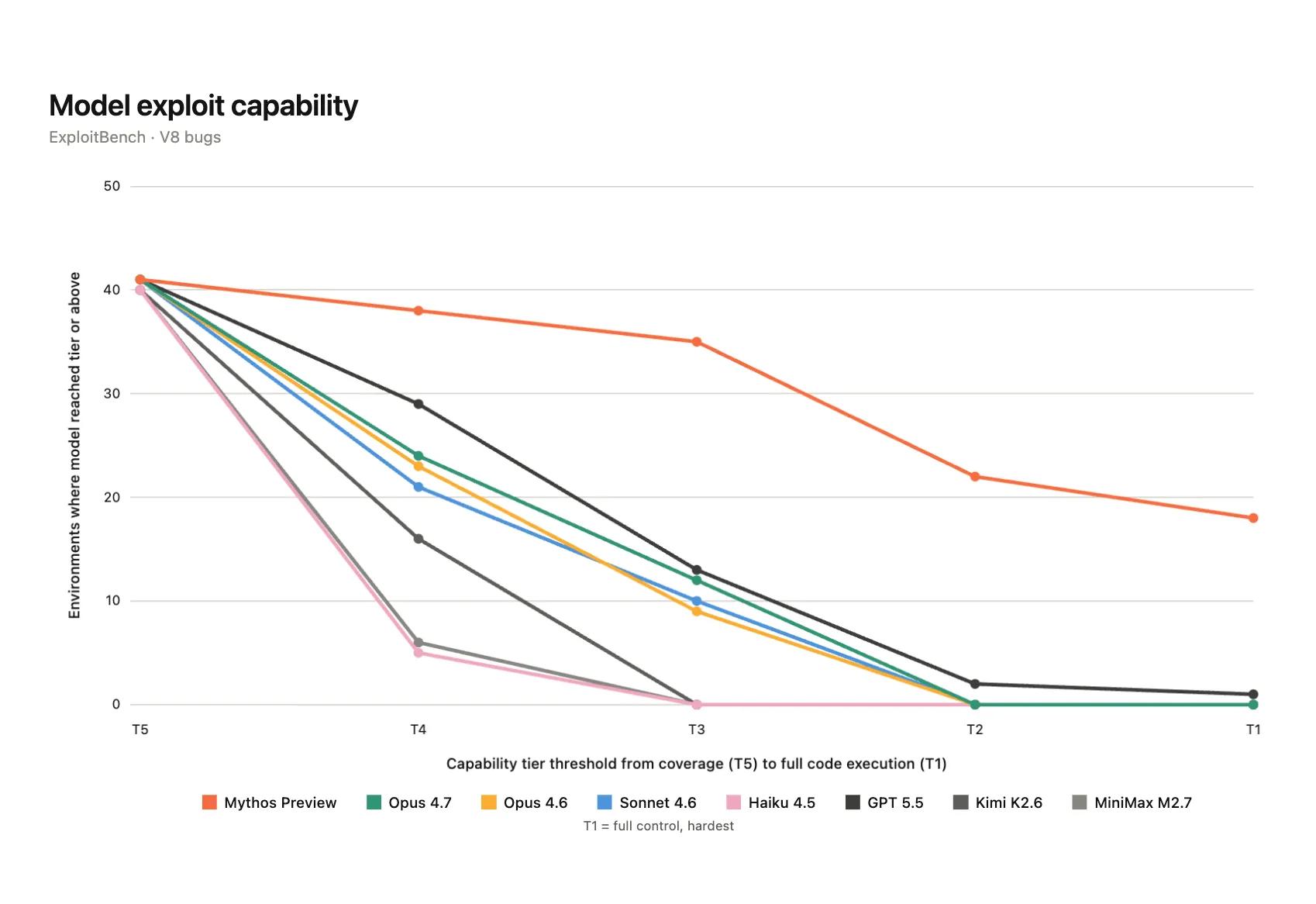
A year ago, the most capable AI models could spot security flaws but couldn't reliably exploit them. Today, in the wrong hands, they can — and not just in simple software. Mythos Preview is the first model to consistently break through the sandbox protections modern browsers and operating systems rely on; other frontier models still stop at the wall. Defenses built on last year's assumptions are already behind.
Reading the chart
Capability trends downward as tasks get harder. T5 is "the model reaches vulnerable code." Only Mythos Preview passed T1: "the model fully controls the system."
Tipping the scales to defenders
In March 2026, Mozilla shipped fixes for vulnerabilities found by Claude Opus 4.6, the model that found hundreds of bugs in open source software that survived decades of human review. With Mythos Preview, Mozilla shipped an additional 271 fixes in the April release, more than 20 times their monthly average. Says Bobby Holley, CTO of Firefox, “Defenders finally have a chance to win, decisively.”
Inside Mozilla's review process
The model expands what gets reviewed, and humans decide what gets patched.
Project Glasswing
Our approach to dual-use with Claude Mythos models
Claude Mythos Preview, and now Claude Mythos 5, are models with significantly stronger cybersecurity capabilities, especially in exploit reasoning. As this capability carries the greatest potential for misuse in security, we are limiting initial access to a small number of partners through Project Glasswing. Claude Fable 5 is our Mythos-class model safe for general use through additional safeguards. Read the latest
Securing critical software
Glasswing partners maintain critical infrastructure or software the world depends on, where a successful attack would be catastrophic.
Expanding through trusted access
We are working toward steadily expanding access to Claude Mythos 5 through a trusted access program, and will share more soon.
Providing tools for defenders today
Claude Security, the open-source reference tools, and the practices emerging from Project Glasswing are available to all security teams.
Across enterprise security programs and inside Anthropic, teams use Claude to improve risk posture.
Find and fix vulnerabilities with Claude Security
Claude Security reasons about your code like a security researcher: scanning for vulnerabilities, validating findings, and proposing targeted patches.
Ship secure code in your CI/CD workflow
Use the Code Review skill to set up automated PR reviews to catch logic errors, security vulnerabilities, and regressions across your full codebase.
Deploy security agents with the Claude Developer Platform
Ship defender tools and custom security agents with sandboxed execution, credential isolation, and audit logging built in via the Agent SDK, MCP, and Claude API.
Build threat context
Give scanning and response a map to work from. Claude derives a threat model from your codebase and past vulnerabilities, then enriches raw indicators with infrastructure links, attribution, and ATT&CK mapping, so analysts start with context.
Vulnerability detection
Claude reads source code the way a researcher does, reasoning about reachability and exploitability, catching vulnerabilities that static tools often miss. A separate triage pass re-verifies every finding to help reduce false positives.
Patching
Findings now arrive faster than teams can fix them. Claude traces each one to its root cause, locates sibling call sites with the same flaw, and writes a minimal diff with a regression test for your team to review.
Triage and verify findings
Hand Claude raw findings from any scanner and get back insights. Claude reads the surrounding code to confirm exploitability, deduplicates by root cause, and ranks by precondition and impact, so engineers can focus and work on real issues first.
Security review across the dev loop
Review code for security at every stage of development. Claude checks its own edits as it writes and fixes issues in the same session, then specialized agents re-examine pull requests against your codebase, posting verified findings inline without blocking your review gates.
Secure source code, end to end
As offensive capability accelerates, the find-and-fix loop has to close faster. Claude runs threat modeling, discovery, verification, triage, and patching as one continuous loop on your codebase, carrying context across every stage so each finding arrives at the fix with its full history.


Frontier capabilities
Leverage powerful models for defense
Claude reads code carefully, understands real risks, and sustains the long workflows that continuous defense requires. Verified practitioners can request adjusted safeguards (opens in new tab) for dual-use work.
Frontier AI capabilities are advancing faster than any single team can respond to, and developers, vendors, researchers, open-source maintainers, and public-sector defenders all have a role to play.
Supporting open-source security
The internet runs on critical software maintained by people with limited resources. We extend access to capable models, fund the foundations behind them, and disclose vulnerabilities responsibly when Claude finds them.
Defending mission-critical systems
We partner with the organizations responsible for the world's most critical software and infrastructure — from Project Glasswing's work hardening systemically important code, to our research with Pacific Northwest National Laboratory (PNNL) on defending cyber-physical systems.
Advocating for policy that backs defenders
Our Advanced AI Framework proposes policies for binding obligations on frontier labs, Anthropic included, and government authority to block dangerous deployments, alongside investment in open-source hardening and the safeguards that would let frontier cyber capability reach more defenders safely.
Everything you need to strengthen your defense posture, from research to implementation guides.
- Measuring LLMs’ impact on N-day exploits
- Expanding Project Glasswing
- Project Glasswing: An initial update
- Measuring LLMs’ ability to develop exploits
- Anthropic's coordinated vulnerabilty disclosure dashboard
- Assessing Claude Mythos Preview’s cybersecurity capabilities
- Reverse engineering Claude's CVE-2026-2796 exploit
- LLM-discovered 0-days
- AI models on realistic cyber ranges
- Finding Bugs with Claude and Property-based Testing
- Experimenting with AI to Defend Critical Infrastructure
- Claude Security: Putting Claude to Work for DefendersWebinar
- How our partners are putting Opus to work for cybersecurityBlog
- How Anthropic's cybersecurity team built a threat detection platform with Claude CodeBlog
- Long Running Agents: How Outtake built a Cyber investigator on ClaudeWebinar
- Partnering with Mozilla to improve Firefox's securityBlog